
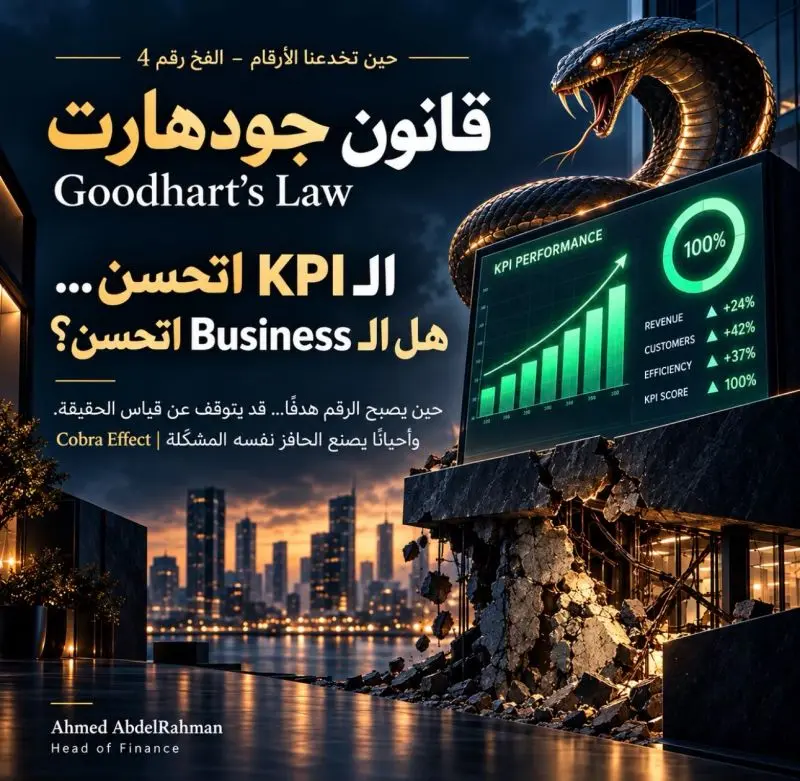
The KPI can genuinely improve while the business deteriorates. That is the central warning behind Goodhart’s Law.
When a measure becomes a direct target, people learn how to improve the measure itself, not necessarily the reality it was designed to represent.
The number is green while revenue quality is falling
A company measures its sales team on revenue alone. The team hits the target and the dashboard is green. But if that number came through deeper discounts, longer payment terms, and lower-margin contracts, revenue has improved while revenue quality has deteriorated.
Or departments are measured on 100% budget compliance. Over time, managers may learn to request more budget than they need so that “meeting” the number becomes easy.
The KPI is no longer merely measuring behavior. It has begun to shape it.
A related but different trap: the Cobra Effect
The name comes from a famous story attributed to British India: authorities reportedly offered a reward for each dead cobra to reduce their numbers. The incentive looked sensible, but some people began breeding cobras to claim the reward. The solution itself created behavior that made the problem worse.
That is the Cobra Effect: an incentive intended to solve a problem produces a response that makes the underlying problem worse.
How does this happen in companies?
A company wants to reduce headcount, so it imposes a strict hiring cap. The number falls, but departments start relying on more expensive contractors and consultants. The goal was lower cost; headcount is down and cost is up.
Or procurement is heavily rewarded for lowering purchase price. It selects a cheaper supplier, but quality falls and returns, downtime, and waste rise. Purchase price improves, but total cost rises.
People may learn to improve the number instead of the reality.
The incentive may create behavior that worsens the original problem.
The two can combine when one KPI is tied to a strong incentive without considering the behavior it will create.
Before approving any KPI or incentive
- If people try to improve the number by any available method, what will they do?
- Can the KPI improve while the business itself gets worse?
- What unintended behavior might the incentive create?
- What counter-metric would reveal the fuller picture?
Good management does not aim for a green dashboard. It aims for reality to improve.
Sometimes the most dangerous choice is not selecting an obviously wrong KPI. It is selecting one that looks right, then rewarding people for improving it without asking how they will do so.
Fallacies, biases, and decision traps finance professionals may face.